
Fifty laws on how deception actually operates — in courts, markets, marriages, and the quiet architecture of your own mind. Hard truths for the mind that refuses to be deceived. Again.
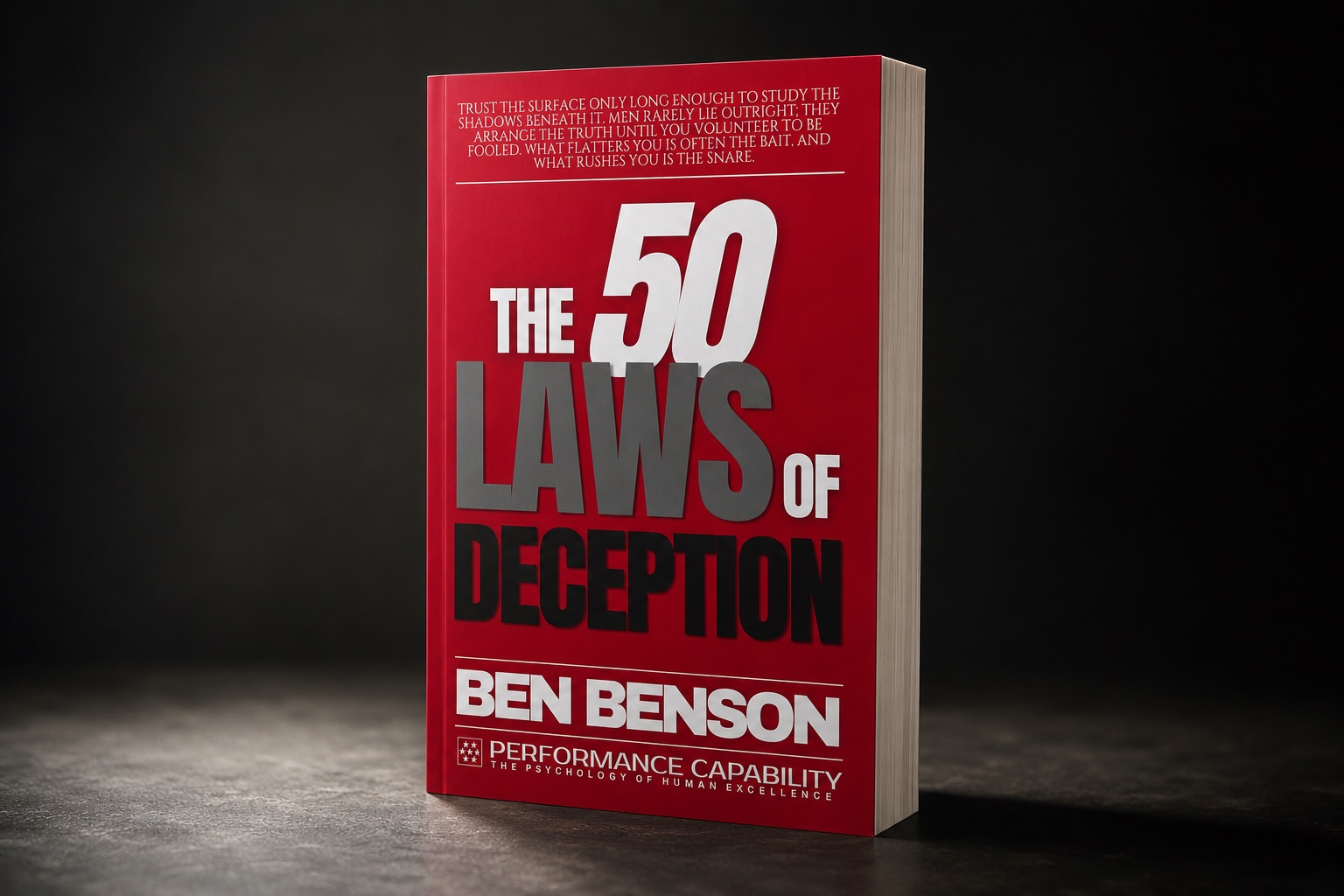
Read Law XI before you buy anything.
Deception is not the exception.
It is the operating system.
Every negotiation you've won contained an anchor someone planted before you sat down. Every promise you've kept was, at some point, weighed against the cost of admitting you were wrong. Every "trusted source" you've ever leaned on was trusted first and verified never.
The 50 Laws of Deception is a field manual for seeing the mechanism — not the morality, the mechanism — behind manipulation, persuasion, and the elaborate stories we tell ourselves to avoid an uncomfortable truth. Each law is built from real cases: a Roman senator's generosity, a gambler's near-miss, a general's patience, a confession timed to bury a bigger crime.
Half the book studies how you are deceived by others. The other half studies something harder to face — how completely, and how routinely, you deceive yourself.
Open Your File
Five questions. No right answers — only the one door you tend to walk through. Takes about 40 seconds.
File Marked: The Flattered Ego
You are not naive — you are competent, and that is exactly the vulnerability. Recognition, when it finally arrives, doesn't feel like bait to you. It feels like confirmation. Somewhere in the last year, someone told you that you were sharper, rarer, or more deserving than the room around you, and you believed them, because on some level it was true. The flatterer rarely lies about your qualities. He simply arrives at the one moment you were most starved to hear them named — and asks for something small in return, right after.
File Marked: The Faithful Investor
You do not quit. In most of your life, that has served you extraordinarily well — it built the career, saved the marriage, finished the degree. But it is also the exact lever a patient deceiver reaches for first. You measure a thing's worth by what you have already sacrificed for it, not by what it is currently giving back, and the longer you've held on, the more unthinkable it becomes to let go. That instinct isn't weakness. It's the most exploitable form of loyalty there is.
File Marked: The Borrowed Certainty
You are careful, which is precisely why this one is hard to see. You have quietly outsourced your judgment to whoever sounded most credible in the room — a title, a track record, a calm and confident tone — and you consult that authority before you consult your own read of the situation. Most of the time this is efficient and mostly harmless. But it means the day someone with borrowed authority decides to mislead you, your first instinct will be to doubt yourself before you doubt them.
A sample from the case file.
Every law opens with an axiom and closes with an antidote. Here's the axiom. Tap a card for the opening line — the rest stays in the book.
Take a free chapter first.
One full law from each edition, sent straight to your inbox. No spam, no drip campaign, just the chapter.
Complete Edition
Get Law XI in full: the mechanism, the historical cases, and the antidote, exactly as it appears in the book.
Short Laws Edition
Get three field-edition laws in their compressed, one-page form: the axiom, the mechanism, the sting.
Read the case in full, or carry the verdicts.
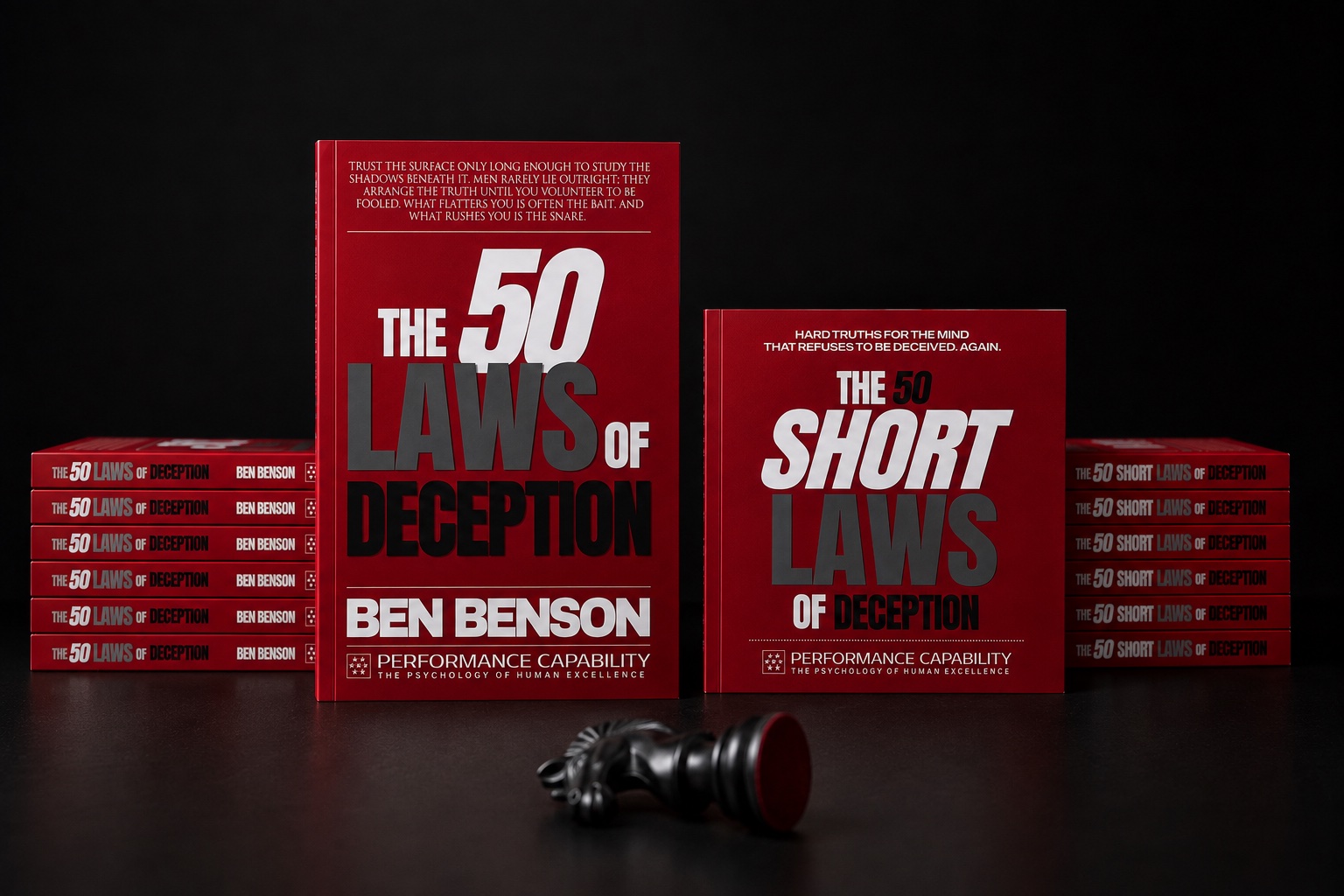
The complete edition and the field edition are built for two different readers — and reference each other throughout.
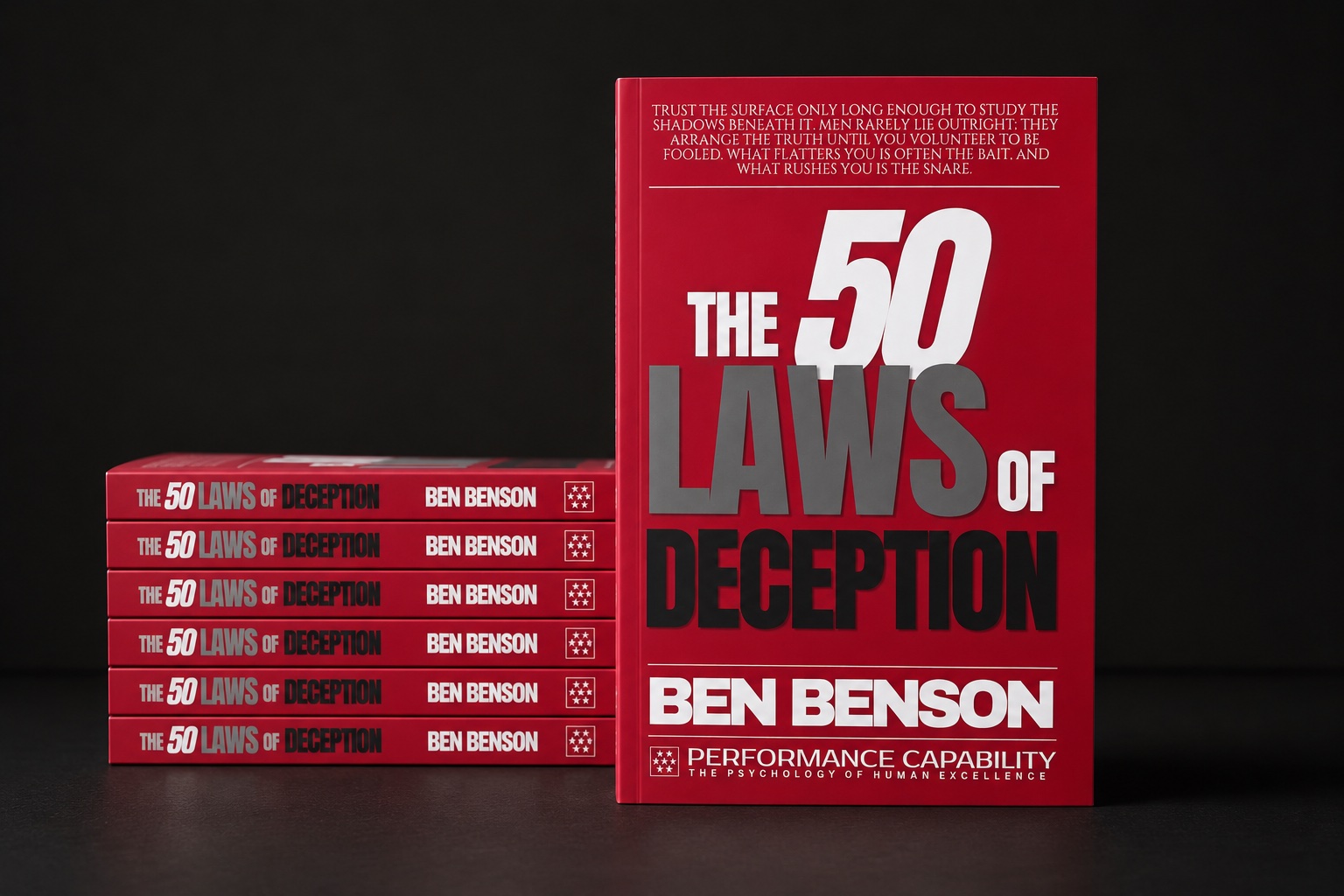
The full case file. Every law with its historical proof, its mechanism laid bare, and its antidote — fifty chapters, no shortcuts.
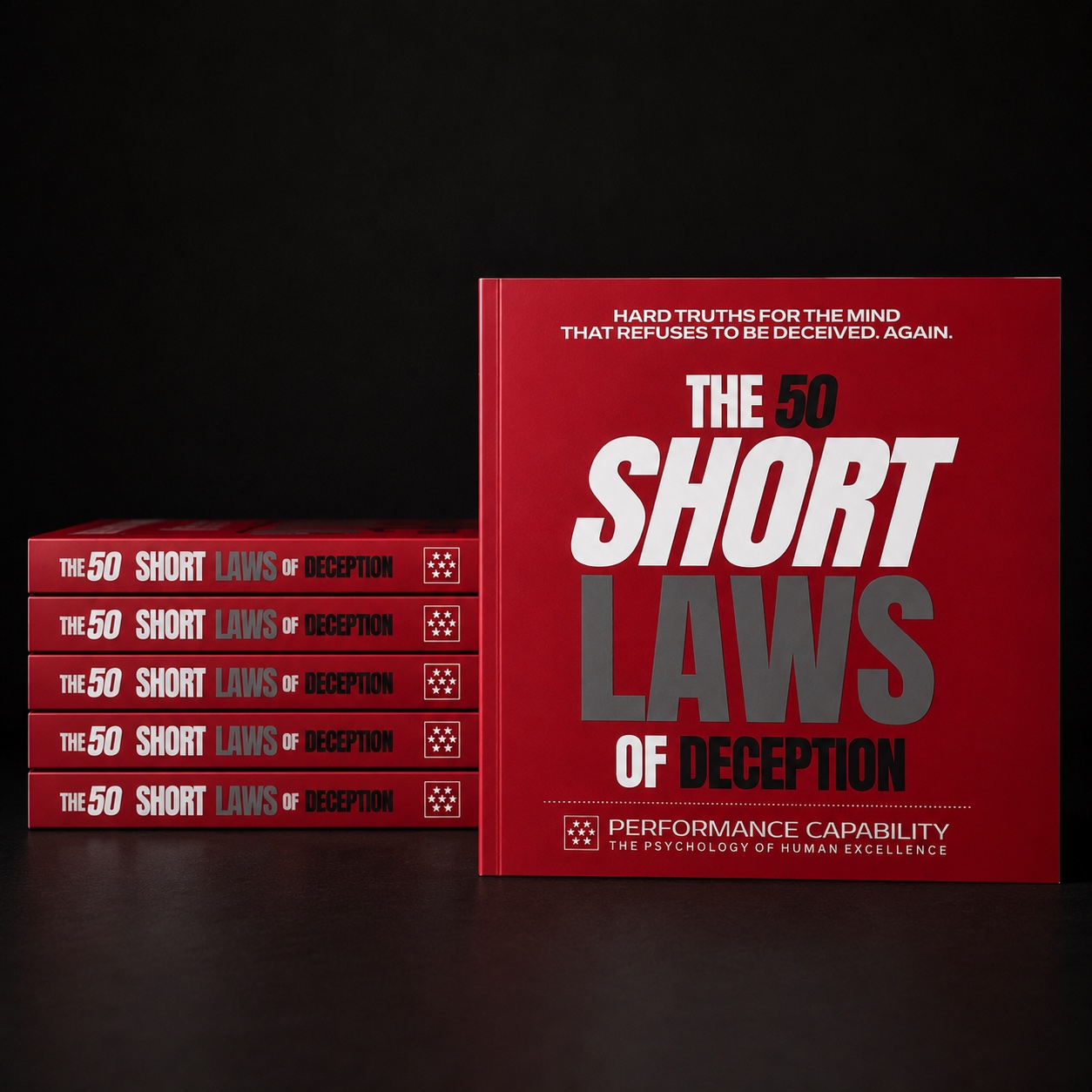
Fifty ruthless principles distilled to their sharpest form — concealing motive, rewriting memory, managing self-image, naming the evasion. The blade without the whole forge.
Ben Benson
Ben Benson is the founder of Performance Capability Group. His work spans organizational capability development — he has worked with elite athletes, founders, executives, and leadership teams across multiple continents. He is also the creator of Trisphereon365.
Each of the fifty laws follows the same discipline: a governing axiom, historical cases drawn from different centuries and different worlds, the underlying mechanism stripped to its bones, and an antidote you can actually use. No two laws repeat the same story. No law asks you to take it on faith. A mirror, not a manual — the deepest danger this book reveals isn't other people. It's the certainty that you've read it and are now safe.
Fifty laws. One mirror. Two ways in.
Read it before someone else uses it on you.
The 50 Laws of Deception
"The lock was the invitation."
- All fifty laws in full, roughly 5,400 words each
- History, mechanism, and antidote for every law
- Built to be read closely, and reread
The 50 Short Laws of Deception
"Every man who has ever been swindled will tell you he saw something was wrong. None of them will tell you why they stayed."
- Fifty laws distilled to one page each
- The axiom, the mechanism, the sting
- Pocket-sized, built to be reopened before you need it